The Architect and the Flaw: An Obituary of Alan Greenspan (1926–2026)
1. The Century of the "Maestro"
Alan Greenspan, who died on June 22, 2026, at the age of 100, was for nearly two decades the "God in the machine" of global finance. Occupying a role widely considered the second most powerful in the United States, Greenspan wielded a level of influence over the dollar and the global economy that rivaled the presidency itself. Born on March 6, 1926, his life spanned a century of economic upheaval, culminating in a nineteen-year tenure as Chairman of the Federal Reserve (1987–2006) under four U.S. presidents. His career followed a dramatic narrative arc: initially hailed as the "Oracle" and the "Maestro" who presided over a golden era of sustained growth, he later became the focal point of a searing re-evaluation following the 2008 financial crisis. To understand the man is to grapple with the tension between his public stature as a central bank technocrat and his unconventional personal origins.
2. From Swing Bands to Central Banking: The Early Years
Greenspan’s legendary analytical approach to data was forged not in the library, but on the road. His unorthodox background as a professional musician provided what he later called "practical insight" into the granular mechanics of American business. Raised in a working-class household in Washington Heights, he attended the Juilliard School to study clarinet before joining the Henry Jerome orchestra as a saxophonist and clarinetist alongside jazz great Stan Getz. While his bandmates spent their breaks smoking marijuana, Greenspan was famously seen swotting up on economics and managing the band’s accounts and tax returns. His intellectual transition toward finance was catalyzed by a book on the British stock exchange, leading him to realize his true calling lay in the markets rather than the conservatory.
Academic and Career Milestones:
- The Pivot to Economics: He left the music circuit to earn a BA (1948) and an MA (1950) in economics from New York University.
- Private Consulting: In 1953, he co-founded Townsend-Greenspan & Co., eventually becoming its sole head and a master of industrial trend forecasting.
- Academic Culmination: He eventually completed his PhD in economics at NYU in 1977.
- Political Entry: He entered the political fray via Richard Nixon’s 1968 campaign. Despite his service, Greenspan remained objectively detached, later describing Nixon as "sadly paranoid, misanthropic and cynical." He went on to chair the Council of Economic Advisers under Gerald Ford.
These early professional successes were deeply influenced by a radical individualist philosophy that would come to define his policy decisions on the global stage.
3. The Disciple: Ayn Rand and the Libertarian Ideology
The ideological bedrock of Greenspan’s career was his relationship with the novelist and philosopher Ayn Rand. Starting in 1952, Greenspan became a core member of Rand’s inner circle, immersing himself in her philosophy of Objectivism, which champion’s "rational self-interest" and a total rejection of state intervention. Rand referred to Greenspan as her "disciple philosophically," though she nicknamed him "the undertaker" due to his signature dark, somber suits.
"If I seem unusually clear to you, you must have misunderstood what I said."
This created an inherent and enduring contradiction: a man who viewed the welfare state as a mechanism for "confiscating the wealth" of productive citizens became the most powerful government actor in the world. Greenspan justified this role by arguing it was more effective to influence the system from within than to critique it from the outside. He brought this "apostle of the free market" mentality directly into the Federal Reserve, where his skepticism of regulation would eventually be put to a definitive test.
4. The Era of Intervention: 1987–2006
Greenspan’s tenure was initially viewed as a "Golden Era" where his decisive responses to crises cemented his status as the "Maestro." His ability to navigate market panics with precision and "Fed-speak"—a style of communication so convoluted it was designed to prevent markets from moving prematurely—became his trademark.
| Crisis/Event | Greenspan’s Action | Short-Term Impact |
|---|---|---|
| 1987 Black Monday | Pledged the Fed as a source of liquidity after the Dow dropped 22.6%. | Calmed markets instantly; prevented a systemic global meltdown. |
| 1997 Asian Crisis | Coordinated rate cuts and a $50bn Mexican peso bailout earlier in '95. | Stabilized "tiger economies" and restored global investor confidence. |
| Dot-com Bubble | Issued "irrational exuberance" warning in 1996; later slashed rates. | The warning set off a panic in Tokyo; the rate cuts cushioned the 2000 burst. |
| 9/11 Attacks | Injected $100bn into the system and aggressively slashed interest rates. | Restored financial confidence and propped up the economy during a national trauma. |
While the U.S. GDP contracted only once during his 19-year tenure, critics later noted that the very tools used to manage these crises—quantitative easing precursors and ultra-low rates—were sowing the seeds of long-term instability.
5. The "Flaw" and the 2008 Financial Crisis
The critical re-evaluation of Greenspan’s legacy began almost immediately upon his retirement, with the 2008 crash casting him as the "closest culprit" for the disaster. Historians and commissions identified a specific chain of failure: his maintenance of low interest rates after 2001, the fueling of the sub-prime mortgage bubble, and a dogmatic reliance on self-regulation. His refusal to regulate complex derivatives—the financial instruments that ultimately crippled the global system—was the direct manifestation of his Randian Objectivism.
"I made a mistake in presuming that the self-interests of organizations, specifically banks and others, were such that they were best capable of protecting their own shareholders."
In a remarkable October 2008 testimony before the House Oversight Committee, Greenspan faced his detractors. He famously admitted he had found a "flaw" in his libertarian ideology and confessed: "I made a mistake in presuming that the self-interests of organizations, specifically banks and others, were such that they were best capable of protecting their own shareholders." This admission of "partially" being wrong was a rare moment of public contrition for a man once considered infallible.
6. The Private Life and Final Years
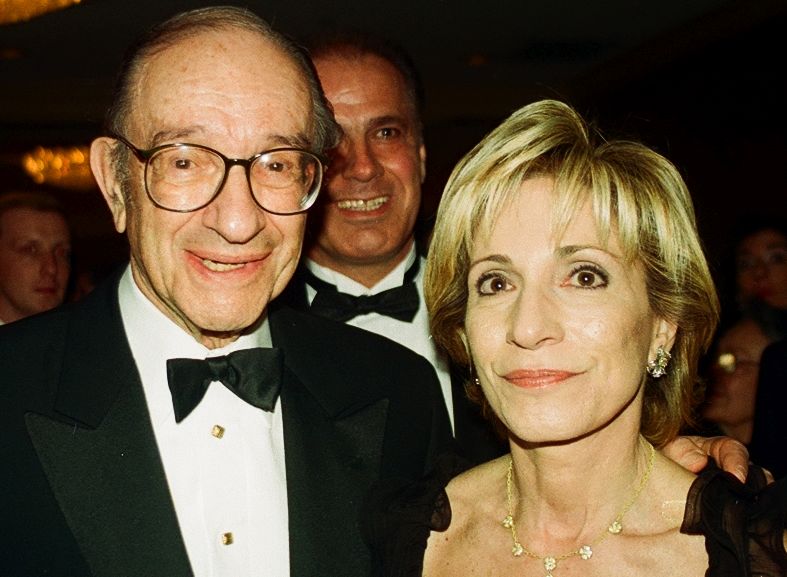
Outside the halls of the Federal Reserve, Greenspan was a man of quiet habits and intellectual rigor. He was a skilled tennis player and shared a life with NBC international correspondent Andrea Mitchell for more than 42 years, following their marriage in 1997. His daily routine was famously punctuated by 90-minute sessions working in a bathtub each morning, a habit born of a need to review data while easing chronic back pain.
In his final decades, Greenspan remained a vocal public intellectual. He authored The Age of Turbulence and Capitalism in America, and frequently critiqued modern political shifts, labeling Donald Trump’s tariffs "insane" and calling Brexit the "worst outcome" for the UK. He remained active until the end, even warning of rapid interest rate hikes in 2023 as he approached his centenary. Alan Greenspan celebrated his 100th birthday in March 2026 before succumbing to complications from Parkinson’s disease in June.
7. Conclusion: A Complicated Legacy
The life of Alan Greenspan remains a definitive fable of an American political culture that both adores its leaders and punishes them for the fragility of the systems they oversee. He was a figure of profound dualities: the jazz musician who mastered the most complex data sets in history, and the libertarian apostle who served as the world’s ultimate government regulator.
Ultimately, his legacy is split between his role as the architect of the longest period of growth in a generation and the man whose philosophical antipathy to regulation permitted the worst downturn since the Great Depression. He was a "giant of a man" whose career serves as a lasting testament to both the immense power of economic theory and the enduring danger of ideological certainty.