Nikkei Surges Past 60,000 as KOSPI Leads Asian Market Rally
· Market News · MarketsFN Team
Nikkei Surges Past 60,000 as KOSPI Leads Asian Market Rally
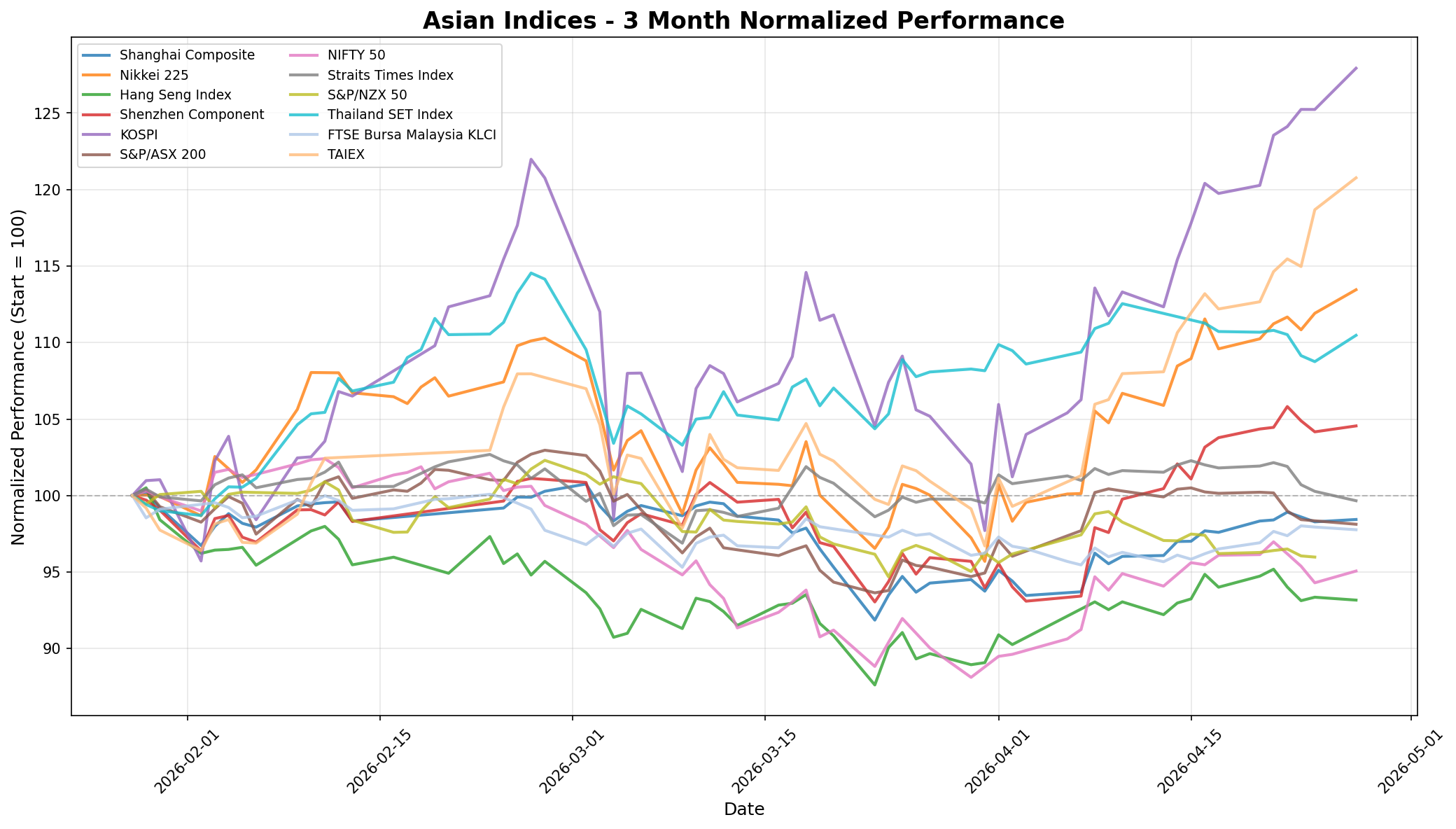
Note: This analysis covers the Asian trading session close for April 27, 2026. All times are in US Eastern Time (ET).
📊 Asian Indices Performance
| Index | Price | Daily Change (%) |
|---|---|---|
| Shanghai Composite | 4,086.34 | +0.16% |
| Nikkei 225 | 60,537.36 | +1.38% |
| Hang Seng Index | 25,925.65 | -0.20% |
| Shenzhen Component | 14,995.75 | +0.37% |
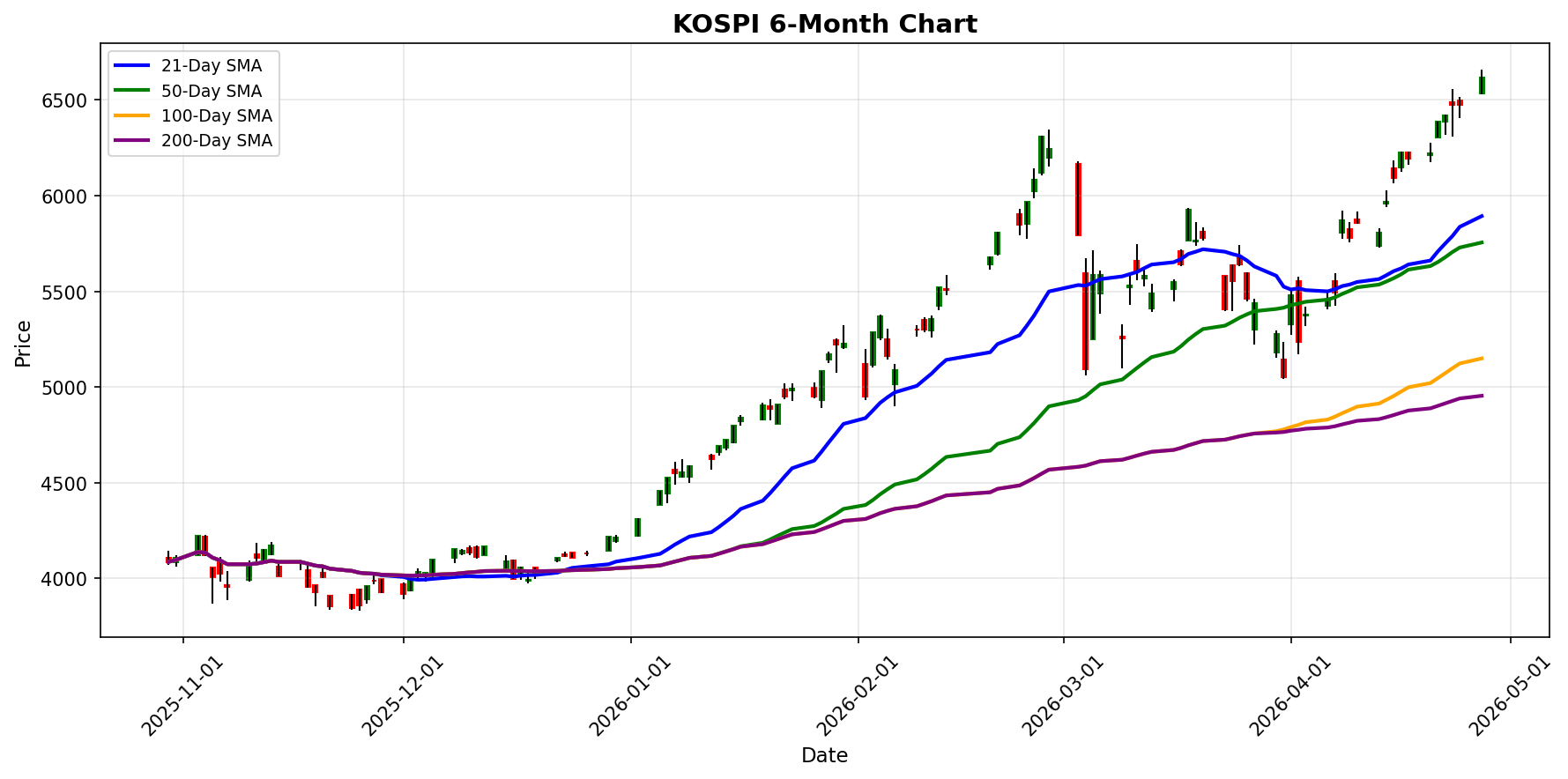
| KOSPI | 6,615.03 | +2.15% |
| S&P/ASX 200 | 8,766.40 | -0.23% |
| NIFTY 50 | 24,092.70 | +0.81% |
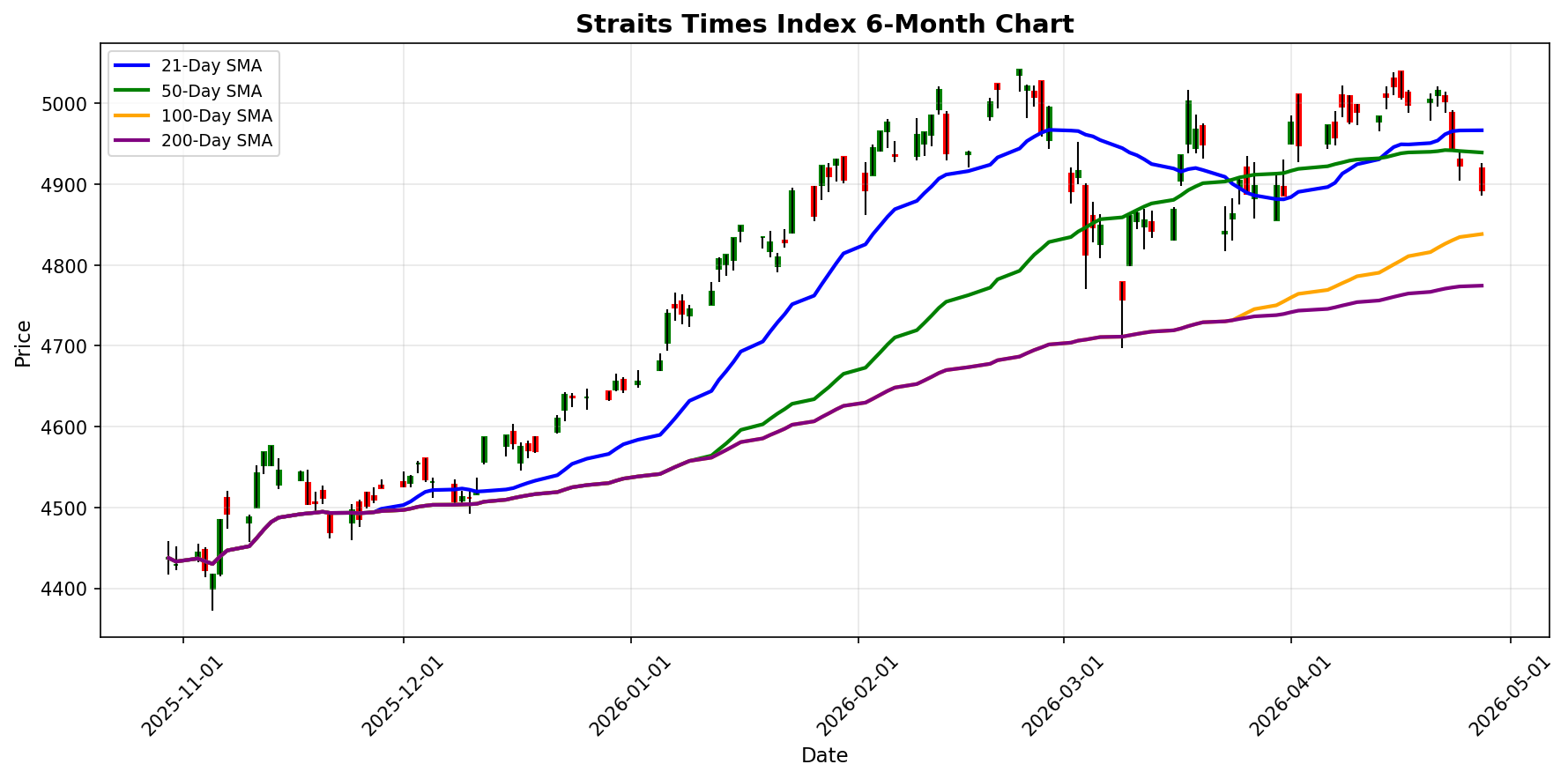
| Straits Times Index | 4,892.73 | -0.61% |
| S&P/NZX 50 | 12,874.94 | -0.08% |
| Thailand SET Index | 1,479.13 | +1.58% |
| FTSE Bursa Malaysia KLCI | 1,717.27 | -0.18% |
| TAIEX | 39,616.63 | +1.76% |
📰 Market Commentary
On April 27, 2026, the Asian markets experienced a mix of performance driven by significant regional developments and market sentiment. **Key Events Impacting Asian Indices:** The Nikkei 225 index in Japan surged above 60,000 for the first time, closing at 60,537.36, a 1.38% increase. This milestone was largely attributed to gains in heavyweight technology stocks, reflecting optimism surrounding tech sector growth. The Bank of Japan (BOJ) is currently assessing its monetary policy amidst ongoing geopolitical tensions, particularly related to the Iran war, which could influence inflation forecasts and economic stability. In contrast, the Hang Seng Index in Hong Kong fell by 0.20% to 25,925.65, reflecting mixed investor sentiment as the region navigates economic uncertainties. The KOSPI in South Korea, however, saw a robust increase of 2.15%, closing at 6,615.03, buoyed by strong demand for technology and manufacturing stocks. **Market Sentiment and Price Movements:** Investor sentiment across the region was generally positive, particularly in Japan and South Korea, where technology stocks drove gains. The Shanghai Composite Index rose by 0.16% to 4,086.34, reflecting a cautious optimism following reports of a 15.8% increase in industrial profits in China, the highest in six months. This growth is seen as a positive signal for the industrial sector amid rising factory-gate prices. Conversely, the Straits Times Index in Singapore and the S&P/ASX 200 in Australia experienced declines of 0.61% and 0.23%, respectively. The mixed performance highlights ongoing concerns about inflationary pressures and geopolitical risks affecting market dynamics. **Regional Economic Developments:** China's economic landscape is shifting, with Guangdong's long-standing dominance as the largest provincial economy facing challenges from Jiangsu, which is narrowing the economic gap. This rivalry reflects the evolving economic dynamics within China, as both provinces exhibit growth rates comparable to G7 nations. In international relations, the visit of Pakistani President Asif Ali Zardari to China underscores efforts to strengthen economic ties, which may have implications for trade and investment flows in the region. Additionally, the rise of Chinese electric vehicles in South Korea, now accounting for one-third of new registrations, signifies a growing competitive landscape in the automotive sector, influenced by external factors such as rising fuel prices linked to geopolitical tensions. Overall, the Asian markets on April 27, 2026, reflect a complex interplay of growth, cautious optimism, and geopolitical challenges, shaping investor sentiment and market movements across the region.
📅 Economic Calendar - Asian Session
All times are in US Eastern Time (ET)
| Date | Time | Cur | Imp | Event | Actual | Forecast |
|---|---|---|---|---|---|---|
| 2026-04-27 | 22:30 | 🇯🇵 | Medium | BoJ Monetary Policy Statement | ||
| 2026-04-27 | 23:00 | 🇯🇵 | Medium | BoJ Outlook Report (YoY) | ||
| 2026-04-27 | 23:00 | 🇯🇵 | High | BoJ Interest Rate Decision | 0.75% |
On April 27, 2026, several significant economic events from Japan are poised to impact traders and Asian indices: 1. **BoJ Monetary Policy Statement** (22:30 ET) - **Actual**: [Data not provided] - **Forecast**: [Data not provided] - **Market Implications**: The monetary policy statement from the Bank of Japan (BoJ) is critical as it outlines the central bank's stance on interest rates and economic outlook. Traders should closely monitor the language used, as any hints towards tightening or easing could lead to volatility in the Japanese yen (JPY) and influence broader Asian market sentiment. 2. **BoJ Outlook Report (YoY)** (23:00 ET) - **Actual**: [Data not provided] - **Forecast**: [Data not provided] - **Market Implications**: The Outlook Report provides insights into the BoJ's economic forecasts, including GDP growth and inflation expectations. A deviation from forecasts could lead to significant market reactions, particularly in Japanese equities and the yen. Positive revisions may boost confidence in the Japanese economy, while negative adjustments could raise concerns among investors. 3. **BoJ Interest Rate Decision** (23:00 ET) - **Actual**: [Data not provided] - **Forecast**: 0.75% - **Market Implications**: The interest rate decision is a high-impact event. If the BoJ maintains the rate at 0.75%, it may reinforce current market expectations. However, any change—either an increase or decrease—could lead to sharp movements in the JPY and Japanese stock indices. A rate hike could signal confidence in economic recovery, while a cut might suggest ongoing concerns about growth. Traders should prepare for potential volatility in the JPY and Japanese equities following these announcements, particularly if actual data diverges significantly from forecasts. Overall, the outcomes of these events will be crucial for assessing the market's
📈 Index Performance Charts
Best Performer: KOSPI
Worst Performer: Straits Times Index
💱 FX, Commodities & Crypto
### FX Pairs Performance **Key Price Movements:** - The USD/JPY pair is trading at 159.2270, reflecting a slight decline of 0.16%. - The USD/CNY has decreased by 0.19%, currently at 6.8223. - In contrast, both the AUD/USD and NZD/USD pairs have shown positive movements, with increases of 0.48% and 0.56%, respectively, at prices of 0.7187 and 0.5913. **Market Drivers:** The fluctuations in FX pairs are influenced by a combination of factors, including interest rate differentials, geopolitical tensions, and economic data releases. The strengthening of the Australian and New Zealand dollars may be attributed to positive economic indicators from those regions, while the slight declines in the USD/JPY and USD/CNY could reflect market adjustments to monetary policy expectations and trade relations. ### Commodities Performance **Note:** No commodities data is available for this report. ### Cryptocurrency Performance **Key Price Movements:** - Bitcoin is currently priced at $77,680, down 1.24% for the day. - Ethereum has seen a more significant decline of 2.54%, trading at $2,310. **Market Drivers:** The recent downturn in cryptocurrency prices appears to be driven by a combination of profit-taking after previous rallies, regulatory concerns, and broader market sentiment influenced by macroeconomic factors. Investor caution surrounding potential interest rate hikes and economic uncertainty may also be contributing to the downward pressure on these digital assets.
Currency Pairs
| Pair | Price | Daily Change (%) |
|---|---|---|
| USD/JPY | 159.23 | -0.16% |
| USD/CNY | 6.82 | -0.19% |
| AUD/USD | 0.72 | +0.48% |
| NZD/USD | 0.59 | +0.56% |
Cryptocurrencies
| Asset | Price | Daily Change (%) |
|---|---|---|
| Bitcoin | $77,680 | -1.24% |
| Ethereum | $2,310 | -2.54% |
Disclaimer
The content on MarketsFN.com is provided for educational and informational purposes only. It does not constitute financial advice, investment recommendations, or trading guidance. All investments involve risks, and past performance does not guarantee future results. You are solely responsible for your investment decisions and should conduct independent research and consult a qualified financial advisor before acting. MarketsFN.com and its authors are not liable for any losses or damages arising from your use of this information.