Multi-Strategy Hedge Funds: A Simple Guide for the Rest of Us
· Alternative Investments · MarketsFN Editorial
Multi-Strategy Hedge Funds: A Simple Guide for the Rest of Us
Published: June 05, 2026 · MarketsFN Editorial
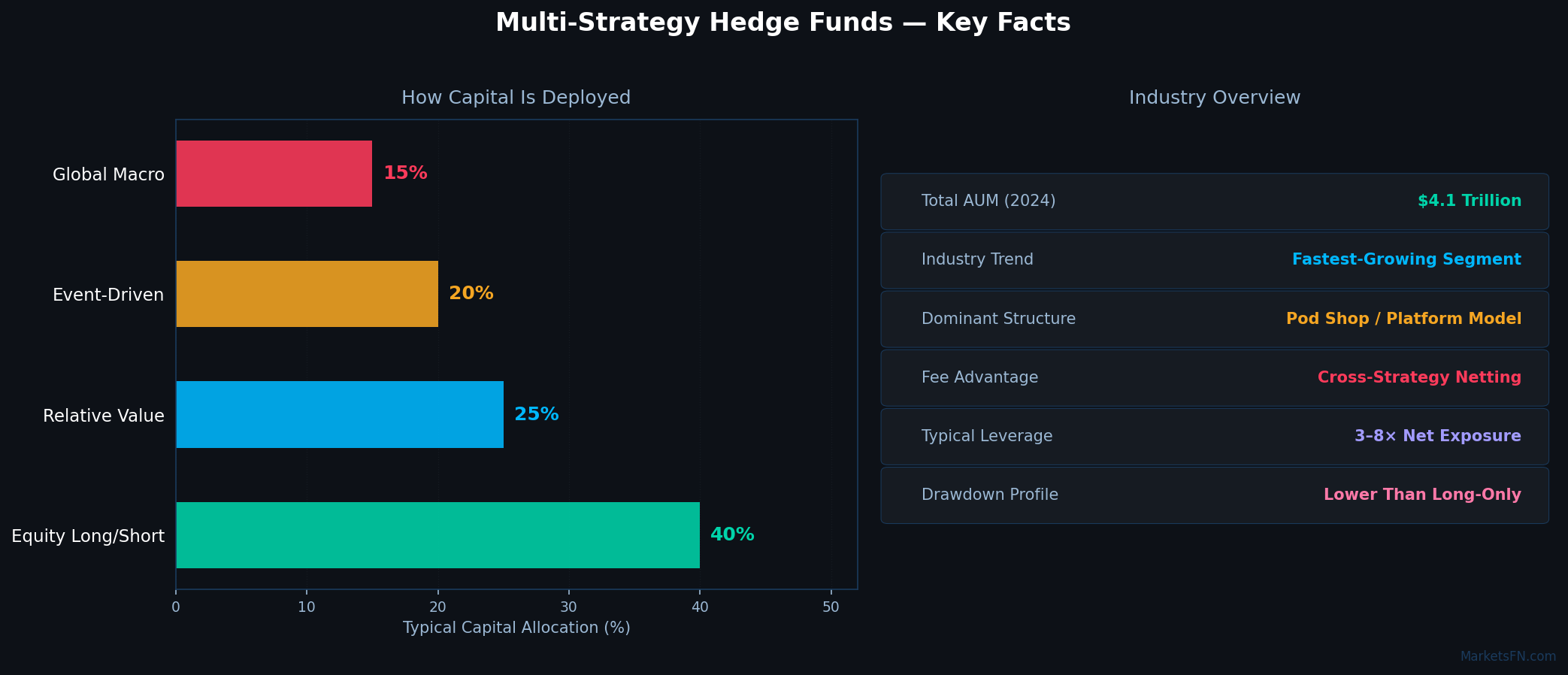
In the world of big-money investing, multi-strategy hedge funds have become the must-have vehicle. In recent years, they have been the fastest-growing part of the hedge fund industry, reaching a staggering $4.1 trillion in assets by 2024. But what exactly are they, and why is everyone talking about them?
What is a Multi-Strategy Hedge Fund?
Think of a traditional hedge fund like a specialist chef who only makes one dish — say, Italian pasta. A multi-strategy fund, on the other hand, is like a high-end food hall. Instead of just one style, it combines many different "mini-funds" (called strategies) into a single investment.
The goal is simple: diversification. By mixing different ways of making money that don't move in sync with each other, these funds aim to provide stable, "all-weather" returns, regardless of whether the stock market is going up or down.
How Are They Built?
These funds usually come in two structures:
The "One-Book" Approach: All the different investment teams work together and share a single pot of profits and losses.
The "Platform" or "Pod" Shop: Currently very popular. The fund is split into many independent teams ("pods") that compete for capital. Each pod runs its own strategy, and central management moves money to the best-performing teams.
The Four Core Strategies
Why Are They So Popular Right Now?
For a long time, investors relied on the "60/40 portfolio" (60% stocks, 40% bonds) as a safety net. However, when both stocks and bonds fall at the same time — as they have recently — that safety net fails. Multi-strategy funds are seen as a modern alternative because of three key advantages:
- Flexibility: Capital moves quickly from losing strategies into winning ones.
- The Netting Benefit: If Team A loses money but Team B gains, the loss is netted before performance fees are calculated — often cheaper than owning two separate funds.
- Lower Drawdown Risk: Spreading bets across many uncorrelated areas limits losses during bad markets.
The Catch: What to Watch Out For
- Pass-Through Fees: Some funds bill investors directly for trader bonuses, technology, and even office costs — making them very expensive.
- Leverage: Borrowed money amplifies both gains and losses.
- Opacity: The "black box" problem — limited transparency into what is actually happening inside the fund.
- Access Barriers: The best funds are often closed to new investors due to capacity constraints.
Summary
Multi-strategy hedge funds are designed to be the ultimate diversifier. They offer a way to escape the roller coaster of the traditional stock market by deploying a small army of specialists to find profit in every corner of the financial world. While complex and often pricey, their ability to deliver steady returns during market chaos has made them a cornerstone of modern institutional investing.
Disclaimer
The content on MarketsFN.com is provided for educational and informational purposes only. It does not constitute financial advice or investment recommendations. All investments involve risks and past performance does not guarantee future results.